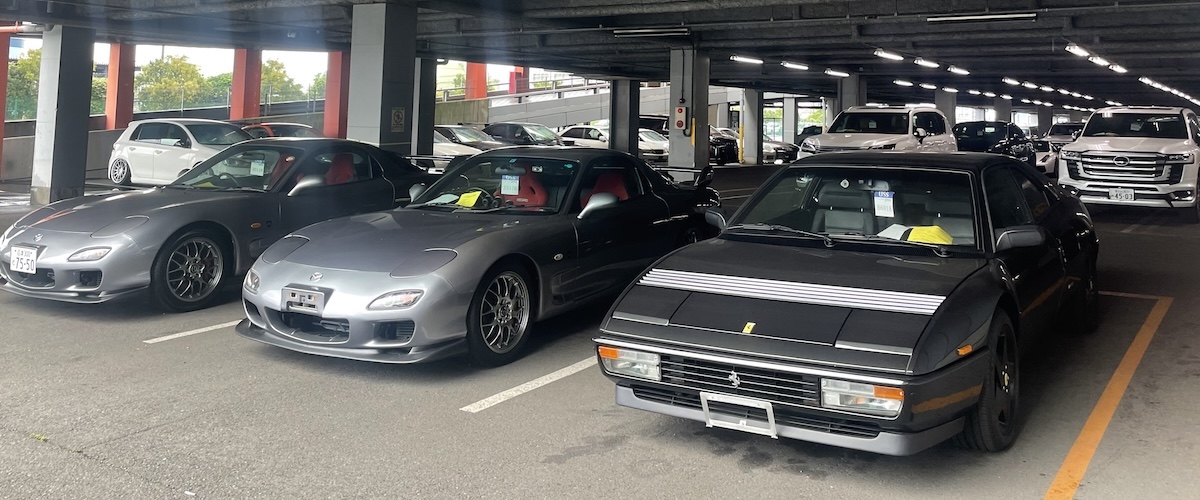
If you spend any time researching how to buy a JDM car, you’ll run into the word “auction” constantly — and you’ll also find a set of websites, like Goo-net and Carsensor, that look like ordinary car classifieds with a price on every listing.
These are two different marketplaces, and telling them apart is the single most useful thing a first-time importer can do. This article explains the first one — Japan’s wholesale dealer auction network — and, just as importantly, how it differs from the retail listing sites where most enthusiasts (and JDM Radar) actually look at cars.
It is not a guide to reading an auction sheet — that gets its own article — and it is not a cost breakdown. It is the map of the territory.
The short version
- “Japanese car auction” means a wholesale, dealer-only marketplace — not the fixed-price listing sites (Goo-net, Carsensor) where most enthusiasts actually browse. The two are different things; this article is about the first, and explains the second.
- Japan runs an enormous used-car auction network — tens of thousands of vehicles change hands through it every week.
- The auctions are business-to-business. Only licensed Japanese dealers can bid — private individuals, Japanese or foreign, cannot.
- A buyer outside Japan participates through a licensed agent or exporter who is an auction member and bids on their behalf.
- Every car is inspected and graded by the auction house. The result is printed on an auction sheet, the single most important document in the whole process.
- Cars sell fast — a handful of seconds each, usually with no chance to start the engine, let alone drive it.
Two marketplaces, not one
Japan’s used-car trade has two layers that matter to a foreign buyer, and confusing them is the most common beginner mistake.
The wholesale layer — the dealer auctions. This is what most of this article is about: USS, JU, TAA and the rest. It is a business-to-business marketplace. Licensed dealers buy cars from other dealers and from leasing companies by bidding. Prices move in real time. Private individuals cannot take part.
The retail layer — the listing portals. Sites like Goo-net (goo-net.com), Carsensor (carsensor.net) and the used-car section of Kakaku.com are consumer-facing. A dealer lists a car at a stated, fixed price — the trade calls this “one price” — and a buyer simply buys it. No bidding, no auction clock.
The two layers are connected, and the connection runs one way. A dealer buys a car at a wholesale auction, reconditions it, sets a retail price, and lists it on Goo-net or Carsensor. The auction is the upstream wholesale exchange; the portal is the downstream shop window. A large share of the cars you’ll browse on a retail portal were bought by that dealer at an auction weeks earlier.
Where JDM Radar fits: JDM Radar curates the retail layer. The cars we feature come from Japan’s used-car listing portals, each with a stated asking price — cars you can simply buy (through an export agent for the logistics), not bid on. We do not deal in the dealer auction network.
So why spend an article on the auctions at all? Two reasons. First, the auction network is the engine that fills the retail portals — understanding it explains where the cars, and the prices, come from. Second, buying directly at auction through an agent is a real alternative route, and plenty of importers take it. Knowing how both layers work makes you a sharper buyer on either one.
Why Japan has this system at all
To understand the auctions, you have to understand why Japan churns through used cars so quickly.
Japan’s vehicle inspection regime — shaken — requires a thorough, expensive inspection every two years for most passenger cars (three years for the first one on a new car). As a car ages, shaken gets more expensive relative to the car’s value, and at some point many Japanese owners conclude it is cheaper to replace the car than to renew it. Combine that with a culture that historically prized newness, low average mileage, and meticulous maintenance, and you get an enormous, constant supply of used cars that are still mechanically excellent but no longer wanted by their first owner.
That supply has to go somewhere, fast. Dealers who take cars in trade, leasing companies offloading returned fleets, and dealers clearing stock they cannot sell locally all need a quick, fair, liquid wholesale channel. The auction network is that channel. It is not a consumer marketplace bolted onto the side of the industry — it is the industry’s plumbing. A used car in Japan is far more likely to pass through an auction than not.
For a foreign enthusiast, that is the opportunity: a deep, liquid, wholesale-priced river of well-kept cars, much of it models that were never sold outside Japan.
Who is actually in the room
Three groups of people matter.
Consignors (出品者, shuppinsha) — the sellers. Mostly dealers (clearing trade-ins and unsold stock), leasing and rental companies (cycling fleet vehicles), and, indirectly, private owners who sell to a dealer that then runs the car through the auction. The seller sets a starting price and, usually, a hidden reserve — the lowest price they will accept.
Bidders — the buyers. Here is the rule that surprises every newcomer: only licensed Japanese used-car dealers can bid. Auction membership requires a Japanese dealer’s licence and, typically, a deposit and references; these member-dealers are the 会員 (kaiin). A bidder is an 応札者 (ōsatsusha); whoever wins the lot becomes the 落札者 (rakusatsusha). What the system does not have is a way for a private individual — Japanese or otherwise — to walk in and bid. There is no consumer tier.
The auction house — the third party that makes the other two trust each other. The venue itself is the オークション会場 (ōkushon kaijō). It takes in each car, inspects it, assigns a grade, prints the auction sheet, runs the sale, handles the money, and arbitrates disputes when a car turns out not to match its sheet. That last function is the quiet reason the whole system works: a buyer bidding in seconds, on a car they cannot touch, is relying entirely on the auction house’s inspection being honest.
The major auction groups
There is no single “Japanese car auction.” There are dozens of auction companies running hundreds of weekly sales across the country. They cluster into a handful of large groups plus a long tail of regional and specialist houses. The Japanese name of each group below links to its official site, if you want to confirm the details or explore further.
USS — Used Car System Solutions (ユー・エス・エス). The largest by a wide margin — well over 30% of the entire market, with tens of thousands of members and auction sites across the country. USS Tokyo is one of the single biggest car-auction venues in the world. USS is a publicly traded company, and its scale means that for most popular export models, it is simply where the most cars are. If you are shopping for choice, USS is the default first stop.
TAA (ティー・エー・エー). A major group with roots in the Toyota world, now running regional auctions under the TAA name (TAA Kinki, TAA Hiroshima, and others). Known in the trade for organised operations and clean, mainstream stock — a common hunting ground for exporters after tidy, sound passenger cars.
JU (JUグループ). Not a single company but a cooperative network — auctions run by prefecture-level used-car dealer associations (JU Tokyo, JU Kanagawa, JU Saitama, and so on). Fifty-plus locations from Hokkaido to Okinawa, well over ten thousand participating dealers, and tens of thousands of cars offered every week across the group. Because it is a cooperative rather than a corporation, the character varies a little from prefecture to prefecture.
ARAI — Arai Auto Auction (アライオートオークション). The third-largest group. Important for passenger cars, but also a serious venue for trucks, vans, machinery and other commercial equipment — worth knowing if you are ever looking beyond passenger cars.
HAA Kobe (兵庫オートオークション). A respected mid-size auction in the Kansai region — HAA here standing for Hyogo Auto Auctions (the acronym is also used by a separate Osaka house, a good reminder that auction-house abbreviations are not always unique). Now part of the USS Group, but still well-regarded in its own right for the quality of what passes through it.
BCN — BCN Auto Auction (BCNオートオークション). A newer, smaller house — launched in 2007, based in Saitama, moving on the order of a couple of thousand cars a week. BCN stands in here for the long tail: beyond the big groups there are many regional and niche auctions, and an interesting or well-priced car can surface at any of them. A good agent watches more than just USS.
AUCNET (オークネット) deserves a separate mention because it works differently: it is an image-and-data auction with no physical lot to walk. Cars are inspected where they sit and sold on the strength of photographs and the inspection report alone. It was an early pioneer of the format that, in one way or another, every auction now offers to remote bidders.
The practical takeaway: you do not pick “an auction.” Your agent has access to a feed that aggregates many of these houses at once, and the same model will appear across several of them every week at different prices and grades.

How a car actually gets sold
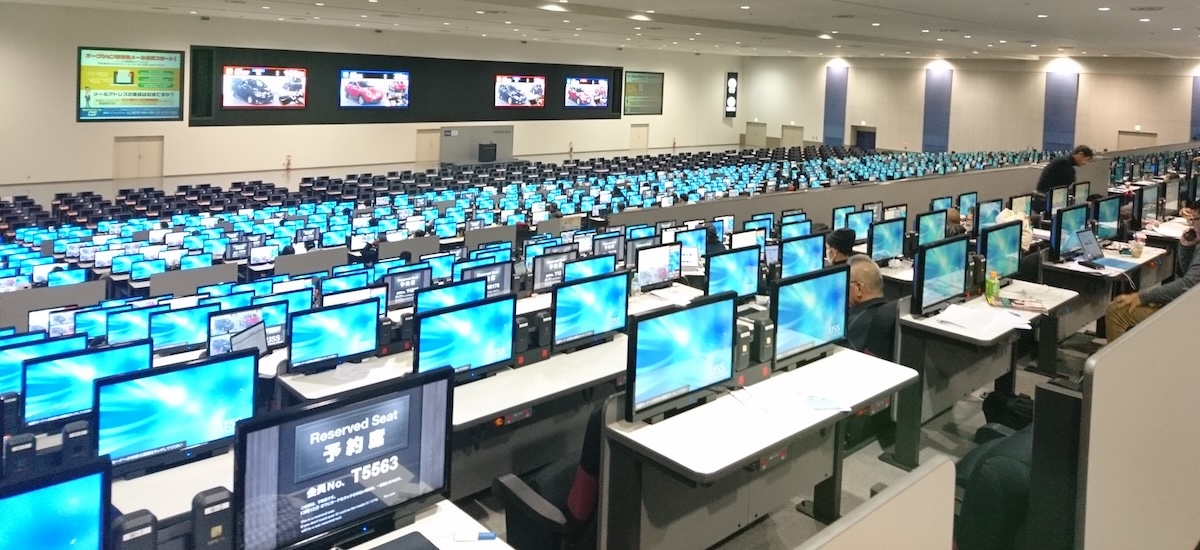
A physical auction is organised into lanes. Cars queue up and roll, one after another, past an auction block with a large display board. The board shows the lot, the starting price, and the live bid as it climbs. Member dealers — some physically present, many bidding online from their own offices — push the price up using a bidding terminal or handset.
The thing that startles newcomers is the speed. A single car is on the block for somewhere between a few seconds and half a minute. There is no walk-around, no engine start, no test drive at the moment of sale. Everything a bidder knows about that car, they knew before it rolled — from the photos, the auction sheet, and whatever inspection they or their agent did in the lane beforehand.
Two mechanics matter:
The starting price and the reserve. The seller sets a starting price (where bidding opens) and, usually, a hidden reserve (the minimum they will actually accept). If bidding stalls below the reserve, the car does not sell — in the trade it is said to have “flowed” (nagareru). It may be re-run at a later sale, often with the reserve lowered.
Proxy bidding. Because no buyer can watch every lane of every auction at once, the system runs largely on maximum bids set in advance. A buyer — or the agent acting for them — enters the highest price they are willing to pay, and the system bids on their behalf up to that ceiling, stopping the moment someone else goes higher. This is the mechanism that lets a buyer on the other side of the world “attend” a Tokyo auction at 3 a.m. their time without being awake for it.
The auction sheet
When a car is consigned, the auction house’s inspector goes over it and produces the auction sheet: a one-page report with an overall grade, separate interior and exterior grades, a diagram of the body marking every dent, scratch and repair, the verified mileage, equipment, and the inspector’s written notes.
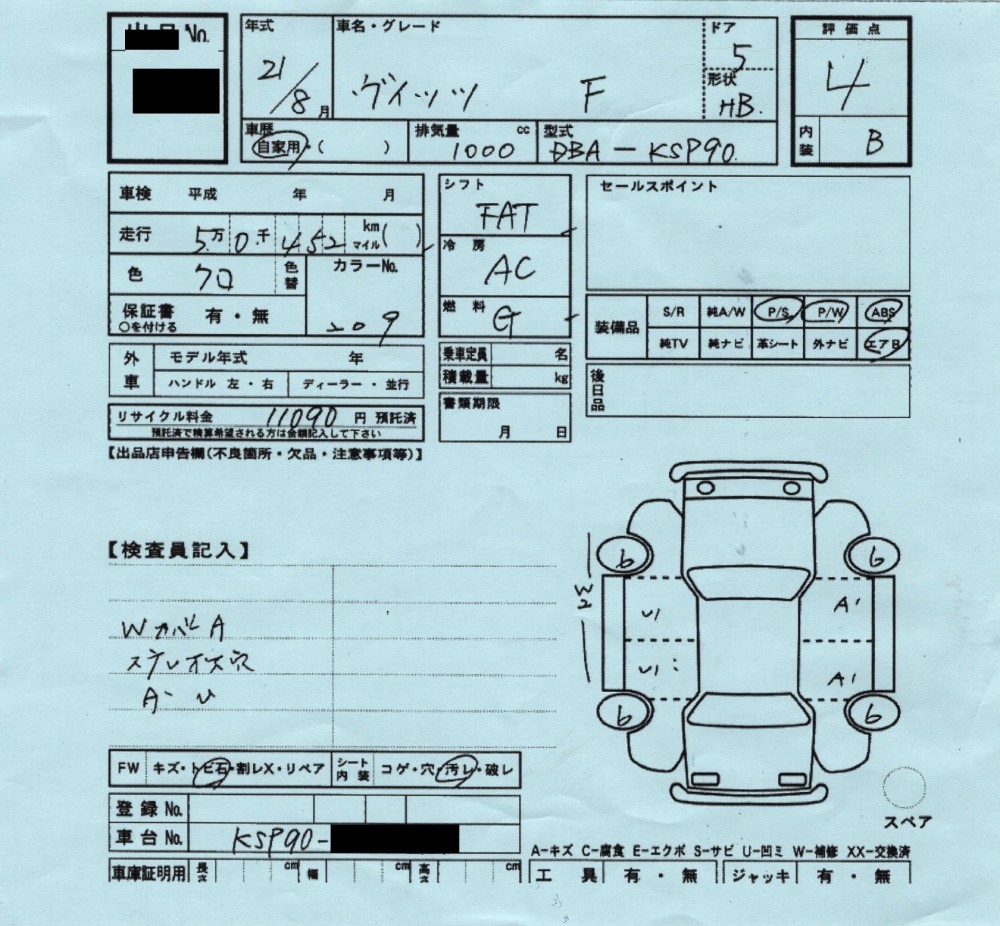
The overall grade runs on a numeric scale — roughly from a top grade for a near-new car down through the 4.5 / 4 / 3.5 / 3 range that covers most ordinary used cars, to low grades and special codes for cars that have been damaged or repaired. The interior gets its own letter grade. The map of the body is where an experienced eye spends the most time.
The auction sheet is the load-bearing wall of the entire system. It is the reason a dealer will spend real money on a car they have looked at for thirty seconds. It is also the thing a remote buyer most needs to be able to read — which is why it gets its own full article. For now, the point is simply: the sheet is the car, as far as the auction is concerned, and learning to read one is the highest-leverage skill in JDM importing.
How a buyer outside Japan actually participates
Recall the rule: only licensed Japanese dealers bid. So how does anyone outside Japan buy a car this way?
Through an agent — sometimes called an auction agent, a deputy bidder, or an exporter. The agent is a licensed auction member. You tell them which car you want and the maximum you will pay; they place the bid; if they win, they take delivery, handle the paperwork, arrange transport to a port, and ship the car. You are buying through a member, not as one.
A few things worth knowing about that relationship:
- The agent translates the sheet. A good agent will read the auction sheet and the inspector’s Japanese notes for you, flag anything concerning, and give you an honest read on condition before you commit a maximum bid. A bad agent will not. This single difference is the biggest variable in a good versus bad import experience.
- You bid blind, together. Even the best agent usually cannot physically inspect every car before it runs — there are too many, too fast. For most cars, the photos and the sheet are what everyone is working from, you and the agent alike.
- There are fees on top of the hammer price. The agent’s commission, auction fees, transport within Japan, export paperwork, shipping, and — in your country — duty, taxes and compliance. The hammer price is the start of the cost, not the end of it. (We will cover the full breakdown in a separate article.)
- Once the hammer falls, you own it. Auction purchases are committed. There is no cooling-off period and no return because you changed your mind. If the car materially does not match its sheet, the auction house’s arbitration process exists — but “I didn’t like it in person” is not a basis for one.
Buying a retail-listed car works much the same way — minus the bidding. If the car you want is a fixed-price listing on Goo-net or Carsensor rather than an auction lot, you still typically go through an export agent: the listing dealer usually will not handle an overseas private sale or the export paperwork directly. But there is no bid and no auction clock — the agent negotiates, or simply pays the asking price, then handles the same export and shipping steps. It is the simpler of the two routes, and it is the layer JDM Radar curates.
What the system is good and bad at
The Japanese auction system is genuinely remarkable, and it has real limits. Both are worth being honest about.
What it does well: scale and liquidity (the model you want runs somewhere most weeks), wholesale-level pricing (you are buying where the dealers buy), and a standardised, independently-produced condition report on every single car. That last point is something most used-car markets in the world simply do not have.
What it does not do: it does not let you drive the car, hear the engine, or have your own mechanic look it over before you commit. The auction sheet is a careful snapshot, but it is a snapshot — taken by an inspector with limited time, recording what was visible on the day. Mechanical condition beyond the obvious is not deeply assessed. And you are bidding against tens of thousands of professionals who do this every day; genuinely underpriced cars are rare, and the good ones attract company.
None of that makes the system a bad way to buy. It makes it a system that rewards preparation — knowing the model, reading the sheet properly, setting a disciplined maximum — and punishes the buyer who treats an auction listing like a classified ad.
What to do next
Understanding how the market works is step one. Step two is the harder problem: out of the thousands of cars listed across Japan’s portals every week, which ones are actually worth pursuing?
That is what JDM Radar does. Every week we go through Japan’s used-car listing portals — the retail layer, with a real asking price on every car — pick out the ones worth a serious look, and present each with the details that matter: translated, in plain language, with the condition notes spelled out. We are not a dealer, an auction agent or an exporter; what we do is the curation step, so that by the time you take a shortlist to whoever handles your purchase, the noise is already filtered out.
- Read this week’s sample issue to see exactly how we present a curated car.
- Browse the newsletter overview for what a subscription includes.
- Start a free 1-month trial for full access to the archive and every car in the current issue.
And if you are reading this because you are close to actually buying: the next thing to learn is how to read a Japanese auction sheet — the condition report at the heart of the auction route. That is the highest-leverage skill if you buy a car that way, and it is the subject of the next article in this series.
JDM Radar is a curation service, not an auction agent or a licensed exporter. Always do your own due diligence and work with a licensed agent you trust before committing to any vehicle.